
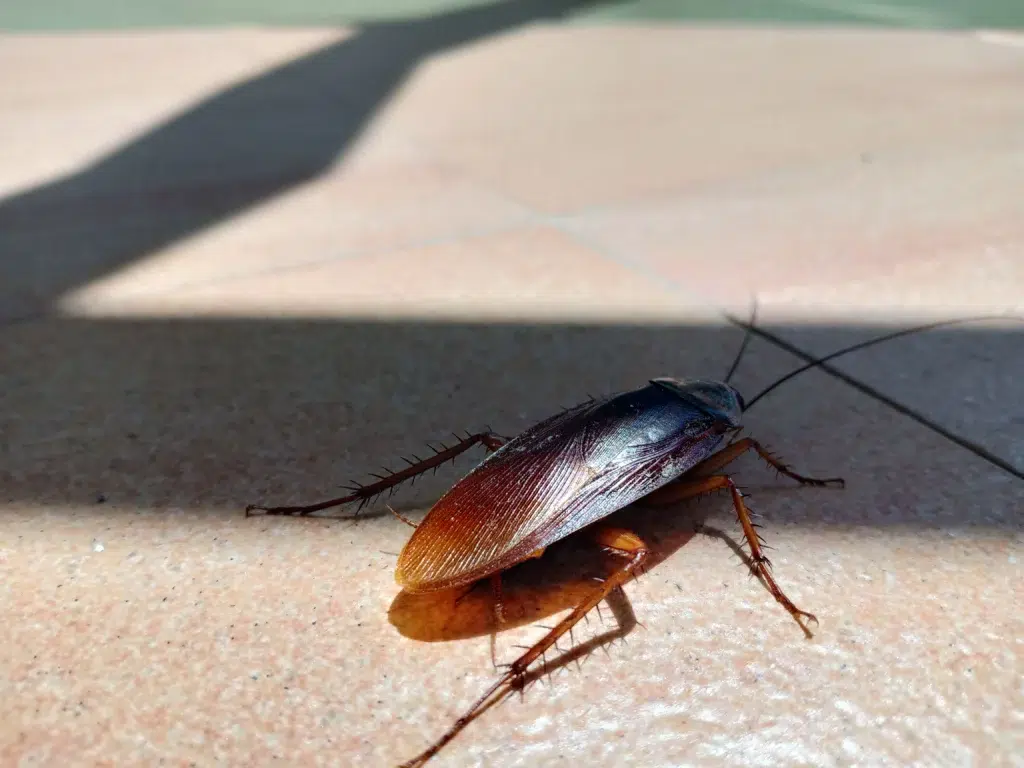
A few cockroaches appear in the kitchen, so you spray the cupboards and skirting boards. They disappear for a few days, then return.The issue may not be your application. German cockroaches hide deep inside cracks, appliances and wall voids, where standard sprays often cannot reach. Correctly placed gel bait is usually more effective for established indoor infestations.
How Spray Works on German Cockroaches
Most household cockroach sprays work in one of two ways.
Contact sprays kill cockroaches when the product is sprayed directly onto them. Residual sprays leave an insecticide deposit on a surface, which may continue working after the product has dried.
That sounds effective in theory, but German cockroaches rarely spend much time in open areas.
They commonly hide in places such as:
- appliance motor cavities
- cupboard hinges
- drawer runners
- gaps behind splashbacks
- cracks around skirting boards
- wall voids
- plumbing penetrations
- spaces around warm electrical equipment
Spraying visible surfaces may kill the cockroaches that come into direct contact with the product, but it often does not reach the main harbourage where the colony is living and breeding.
In many cases, the treatment covers the areas cockroaches briefly travel across rather than the hidden areas where most of the infestation is concentrated.
Why Spray Can Spread the Problem
Some cockroach sprays have a repellent effect. This means German cockroaches may detect the treated area and avoid crossing it.
Instead of feeding on or travelling through the treated surface, they may change direction and move into another hiding place.
In a house, this can push cockroaches deeper into cupboards, wall cavities, ceiling spaces or other rooms. In an apartment building, they may move through shared plumbing penetrations, wall voids and service areas.
This can create the impression that the spray has worked because cockroach activity disappears from the kitchen for a few days. However, the colony may have moved rather than been eliminated.
The infestation can then return once the chemical residue weakens or the cockroaches establish themselves in another part of the property.
This does not mean every spray application will make an infestation worse. However, repeated use of repellent products in the wrong areas can make German cockroaches harder to locate and treat.
Stop German Cockroaches Before They Spread
Noticing cockroaches in your kitchen or bathroom? Pest Power Sydney can identify where they are hiding and recommend the right combination of baiting, treatment and follow-up care.
How Gel Bait Works Differently
Gel bait takes a different approach.
Instead of trying to repel cockroaches, gel bait is designed to attract them. Small amounts are placed close to the cracks, gaps, appliances and sheltered areas where cockroaches travel, feed and hide.
The cockroaches leave their harbourage, consume the bait and return to the area where the colony is concentrated.
Depending on the product used, other cockroaches may also be exposed through contact with contaminated faeces, secretions or dead cockroaches. This is often referred to as secondary transfer.
This secondary effect can help expose cockroaches that did not feed directly on the bait.
Gel bait can also be placed in areas where broad spraying would be unsuitable, such as inside cupboards, near electrical equipment and around appliance cavities. It must still be applied according to the product label and kept away from food preparation surfaces.
Why Correct Bait Placement Matters
Gel bait is not effective simply because it is stronger than spray. Its success depends heavily on where and how it is applied.
German cockroaches tend to remain close to warmth, food, moisture and sheltered hiding places. Bait placed in the middle of a cupboard shelf or another open area may receive little attention.
More effective placement points may include:
- behind refrigerators and dishwashers
- near appliance motors
- inside cupboard hinges
- around drawer runners
- below sinks
- around plumbing penetrations
- close to cracks and crevices
- near identified cockroach droppings or egg cases
Small, targeted placements are generally more effective than applying large amounts in open areas.
An inspection is therefore one of the most important parts of German cockroach treatment. It helps determine where the cockroaches are harbouring and where bait is most likely to be consumed.
The Role of Insect Growth Regulators
Reducing the number of adult cockroaches is only part of the treatment.
German cockroaches reproduce quickly, and their egg cases can contain numerous developing nymphs. Even when visible adults are reduced, young cockroaches may continue emerging after the initial treatment.
Insect growth regulators, commonly known as IGRs, can help interrupt this cycle.
An IGR does not usually kill cockroaches immediately. Instead, it interferes with their development and reproductive process. Nymphs exposed to an appropriate IGR may be unable to mature normally into breeding adults.
When used correctly alongside gel bait, an IGR can help address both the active population and the cockroaches that may emerge later.
This is why professional cockroach pest control often uses several control methods rather than relying on one product alone.
When Cockroach Spray Can Still Be Useful
Spray is not completely useless.
Residual spray can still play an important role in pest control when it is used in the correct areas and for the correct cockroach species.
It may be suitable for:
- exterior perimeter treatments
- door thresholds
- cracks around external walls
- weep holes, when the product is approved for that use
- garages and sheds
- areas where larger outdoor cockroach species enter the property
Spray may be more effective against species such as American or Australian cockroaches, which are often associated with gardens, drains, roof spaces and external areas.
German cockroaches are different. They usually establish themselves indoors, particularly in kitchens, laundries and bathrooms where food, warmth and moisture are readily available.
For this species, correctly placed gel bait is generally a more targeted treatment than spraying large indoor surfaces.
Can Spray and Gel Bait Be Used Together?
They can, but not in the same places, and the order matters. Spraying a residual insecticide over or beside gel bait contaminates it: German cockroaches avoid the treated bait and stop feeding, which removes the transfer effect that makes gel work in the first place.
The way it is done properly is to keep them apart. Gel goes into the harbourage where the cockroaches live, in cracks, hinge voids, motor housings and under benches. Any spray is kept to the perimeter and to surfaces the bait is not on, and is applied after the gel has done its work rather than at the same time.
Common reasons DIY baiting fails include:
- placing bait too far from the harbourage
- applying it in open or exposed locations
- using too much bait in one spot
- spraying repellent products nearby
- failing to remove competing food sources
- not treating all affected rooms
- overlooking egg cases and newly emerging nymphs
- failing to replace bait after it dries out or is consumed
German cockroaches may also develop bait aversion or resistance to certain active ingredients. Using the same product repeatedly may therefore become less effective over time.
A professional pest exterminator can inspect the property, identify the main harbourage areas and choose treatment products based on the conditions present.
The main difference is not always access to a stronger product. It is knowing where the infestation is concentrated and applying the right treatment in the right place.
Why DIY Gel Bait Sometimes Fails
Buying gel bait from a supermarket or hardware shop does not guarantee that the infestation will disappear.
Common reasons DIY baiting fails include:
- placing bait too far from the harbourage
- applying it in open or exposed locations
- using too much bait in one spot
- spraying repellent products nearby
- failing to remove competing food sources
- not treating all affected rooms
- overlooking egg cases and newly emerging nymphs
- failing to replace bait after it dries out or is consumed
German cockroaches may also develop bait aversion or resistance to certain active ingredients. Using the same product repeatedly may therefore become less effective over time.
A professional pest controller can inspect the property, identify the main harbourage areas and choose treatment products based on the conditions present.
The main difference is not always access to a stronger product. It is knowing where the infestation is concentrated and applying the right treatment in the right place.
The Importance of Cleaning and Moisture Control
Even well-placed bait may struggle if cockroaches have access to plenty of alternative food and water.
Before and after treatment, it helps to:
- wipe grease and food residue from benches
- clean underneath and behind appliances
- store food in sealed containers
- empty rubbish regularly
- avoid leaving pet food out overnight
- repair leaking taps and pipes
- dry sinks and wet surfaces before bed
- remove cardboard and unnecessary clutter
Cleaning alone will not usually eliminate an established German cockroach infestation. However, reducing food, water and hiding places can make bait more attractive and improve treatment results.
Which Treatment Works Best?
For an established German cockroach infestation, gel bait is generally more effective than relying on household spray alone.
Spray may kill individual cockroaches, but it often does not reach the main harbourage. Certain repellent sprays may also cause cockroaches to avoid treated areas and move into other parts of the property.
Gel bait works by encouraging cockroaches to feed and return to their hiding places. When it is placed correctly and combined with an IGR, sanitation and follow-up monitoring, it can provide more complete control.
However, gel bait is not a quick fix. The treatment must be applied in the correct locations, protected from contamination and monitored over time.
Having it dealt with properly
Choosing wrongly between the two is the most common reason a German cockroach job fails, and using them in the wrong order can cancel the bait entirely.
On a cockroach job the inspection goes to the harbourage rather than the open floor: motor housings, hinge voids, the cavity behind the kickboard, under the sink and the back of the dishwasher. Gel bait goes into those voids with an insect growth regulator, and a follow-up four to six weeks later catches the generation that hatches after the first visit. Cockroach treatments start from $89 for a standard unit or small home, every job is quoted in writing, and the work carries a six-month warranty. Pest Power Sydney provides cockroach pest control in Sydney, and the work is carried out by the owner-operator, Mac Naji, and his technicians, who are the people customers name in the reviews. Call 0412 931 208 for a quote or a same-day inspection.
If you are working through this, it is worth also reading how long German cockroach spray keeps working, why German cockroaches are the hardest to eliminate and where supermarket cockroach remedies stop working.
“Mac tried to identify the root cause of pest by having detailed chat with us & started treatment accordingly. He did his best and took extra efforts to make sure pest should be in control. I highly recommend to approach Pest Power MAC for his excellent service. Appreciate Pest Power team! Thank you” — a Google review of Pest Power Sydney. The business holds a 5.0 rating from more than 320 Google reviews.
When to Call a Professional Pest Controller
A small and recently discovered infestation may sometimes be managed with careful bait placement and improved cleaning.
Professional Pest control services assistance is worth considering when:
- cockroaches are active during the day
- you regularly find nymphs or egg cases
- the infestation keeps returning
- several rooms are affected
- cockroaches are inside appliances
- you live in an apartment or shared building
- DIY sprays and baits have not worked
- the infestation is affecting a commercial kitchen or food business
If your kitchen or bathroom has an ongoing German cockroach problem, Pest Power Sydney can inspect the property, identify likely harbourage areas and recommend a treatment plan based on the conditions in your home.
Rather than repeatedly applying products and hoping they reach the colony, a targeted inspection helps determine what is causing the infestation to continue and which treatment methods are most suitable.
Frequently Asked Questions
Is gel bait better than spray for German cockroaches?
Gel bait is generally more effective for established German cockroach infestations because it can be placed close to hidden harbourage areas. Cockroaches leave their hiding places to consume the bait and may expose others within the colony through secondary transfer.
Spray can kill cockroaches on contact, but it may not reach those hiding inside appliances, cracks, wall voids and cabinetry.
How long does gel bait take to work?
You may notice a reduction in cockroach activity within several days or weeks. Complete control can take longer depending on the size of the infestation, the location of the harbourage, sanitation conditions, bait placement and whether follow-up treatment is required.
New cockroaches may also emerge from existing egg cases after the first application.
Can I use spray and gel bait at the same time?
Spray should not be applied directly over or close to gel bait unless the product label confirms that they are compatible.
Repellent residues may discourage cockroaches from feeding on the bait or may contaminate it. When both products are used, they should be applied strategically in separate areas.
Why did the cockroaches return after spraying?
Household spray may kill the cockroaches you can see without reaching the main colony.
Some sprays may also cause German cockroaches to avoid the treated area and move into nearby cracks, cavities or rooms. Once the residue weakens, activity may return.
Do professional treatments use spray or gel bait?
Professional treatments may use gel bait, IGRs, dusts, non-repellent insecticides and targeted residual sprays.
The products and application methods depend on the cockroach species, infestation level, property layout and location of the harbourage.
Can I eliminate German cockroaches without professional help?
A small infestation may sometimes be controlled with careful bait placement, cleaning, moisture reduction and regular monitoring.
However, German cockroaches breed quickly and can hide inside very small gaps. If activity continues, spreads to several rooms or returns after treatment, a professional inspection is likely to provide a more reliable result.
Trusted Pest Exterminators – Contact Us Now
Choosing between spray and gel? The two do different jobs, and German cockroaches usually need the bait. Pest Power Sydney provides gel bait cockroach treatment.